
Key Takeaways
- TMS therapy is an FDA-approved, noninvasive brain stimulation treatment for depression that does not require medication, anesthesia, or sedation.
- TMS works by delivering targeted magnetic pulses to the left dorsolateral prefrontal cortex, a brain region that tends to be underactive in depression.
- A standard treatment course involves 20 to 30 sessions over four to six weeks, with each session lasting approximately 20 to 40 minutes.
- Many patients with treatment-resistant depression experience meaningful improvement with TMS, though results differ between individuals and depend on the protocol and degree of prior treatment resistance.
- Most patients can drive themselves to and from appointments and return to normal activities immediately after each session.
- KwikPsych offers TMS therapy in Austin, TX, with board-certified psychiatric oversight from initial evaluation through the full treatment course.
What Is TMS Therapy?
TMS therapy, or transcranial magnetic stimulation, is a noninvasive neuromodulation procedure that uses focused magnetic pulses to stimulate nerve cells in specific areas of the brain. The FDA first approved TMS for treatment-resistant major depressive disorder in 2008, and it has since become one of the most widely studied alternatives to medication for people whose depression has not responded adequately to antidepressants.
Unlike electroconvulsive therapy (ECT), TMS does not require anesthesia, does not induce a seizure, and does not cause the cognitive side effects that many patients associate with brain stimulation treatments. You remain fully awake during the procedure, seated in a comfortable chair, and can return to your daily routine immediately afterward.
TMS is sometimes described as a treatment for "treatment-resistant" depression, but that clinical threshold is more specific than it sounds. In most protocols, treatment resistance means that at least one adequate trial of antidepressant medication — defined as four or more weeks at a therapeutic dose — has not produced sufficient improvement. Roughly 30 to 50 percent of people with major depression do not respond to their first antidepressant, and about 20 percent remain symptomatic after two or more adequate trials. TMS was developed to fill that gap.
How TMS Works
TMS delivers brief magnetic pulses through a coil placed against the scalp over the left dorsolateral prefrontal cortex (DLPFC). This region plays a central role in mood regulation, executive function, and emotional processing, and neuroimaging studies consistently show reduced activity in this area among people with depression.
Each magnetic pulse generates a small electrical current in the targeted cortical tissue, activating neurons that have become underactive. Over the course of repeated sessions, this stimulation appears to normalize activity in the DLPFC and its connections to deeper limbic structures involved in mood, motivation, and stress response.
The magnetic field used in TMS is similar in strength to an MRI scanner but is applied in brief, focused pulses rather than continuously. The pulses do not pass through the entire brain — they penetrate roughly two to three centimeters below the scalp surface, which is why the treatment is considered focal and noninvasive.
Motor Threshold Calibration
Before your first treatment session, the clinician determines your individual motor threshold — the minimum magnetic intensity needed to activate the motor cortex and produce a visible thumb twitch. This measurement ensures that the stimulation intensity is calibrated specifically for your brain. Treatment is then delivered at 120 percent of your motor threshold, a level shown to balance effectiveness with tolerability.
Conditions Treated with TMS
The primary FDA-approved indication for TMS is major depressive disorder in adults who have not responded adequately to at least one antidepressant medication. Within that indication, TMS has the strongest evidence for the following:
- Depression — The core indication. TMS is most commonly used for unipolar major depressive disorder that has been moderate to severe and has not improved sufficiently with medication alone.
- Obsessive-compulsive disorder (OCD) — Deep TMS received FDA clearance for OCD in 2018. Protocols targeting the anterior cingulate cortex and medial prefrontal cortex have shown benefit for patients whose OCD has not responded adequately to standard treatment.
- Anxiety disorders — While TMS is not FDA-approved specifically for anxiety, clinical research shows that TMS for depression often produces meaningful improvement in co-occurring anxiety symptoms as well.
- PTSD — Emerging evidence supports TMS as an adjunctive treatment for PTSD, though this remains an area of active research rather than a standard indication.
Your psychiatrist will determine whether TMS is appropriate for your specific diagnosis and treatment history during the initial evaluation.
Who Is a Candidate for TMS?
TMS may be appropriate if you meet several clinical criteria. The most common profile is an adult with major depressive disorder who has tried at least one antidepressant at an adequate dose for an adequate duration without sufficient improvement. In clinical terms, this means you have treatment-resistant depression.
You May Be a Good Candidate If You
- Have been diagnosed with major depressive disorder
- Have tried at least one antidepressant at a therapeutic dose for four or more weeks without adequate response
- Are looking for a treatment that does not involve additional medication
- Can commit to attending sessions five days per week for four to six weeks
- Want to avoid the cognitive side effects associated with ECT
TMS May Not Be Appropriate If You Have
- Metallic implants in or near the head (certain aneurysm clips, cochlear implants, or implanted stimulators)
- A cardiac pacemaker or implanted cardioverter-defibrillator
- A history of seizure disorder (this is a relative contraindication — your psychiatrist will assess the risk individually)
- Psychotic features as part of your depression (ECT is generally preferred in this situation)
A thorough psychiatric evaluation before starting TMS is essential. At KwikPsych, the evaluation includes a full review of your diagnosis, medication history, prior treatment response, and any safety considerations that could affect your candidacy.
What to Expect During Treatment
Before Your First Session
Your treatment begins with a comprehensive psychiatric evaluation, during which your psychiatrist reviews your depression history, previous medications, treatment response, and medical history. If TMS is appropriate, the team will schedule your first session and explain the full treatment timeline.
During a Session
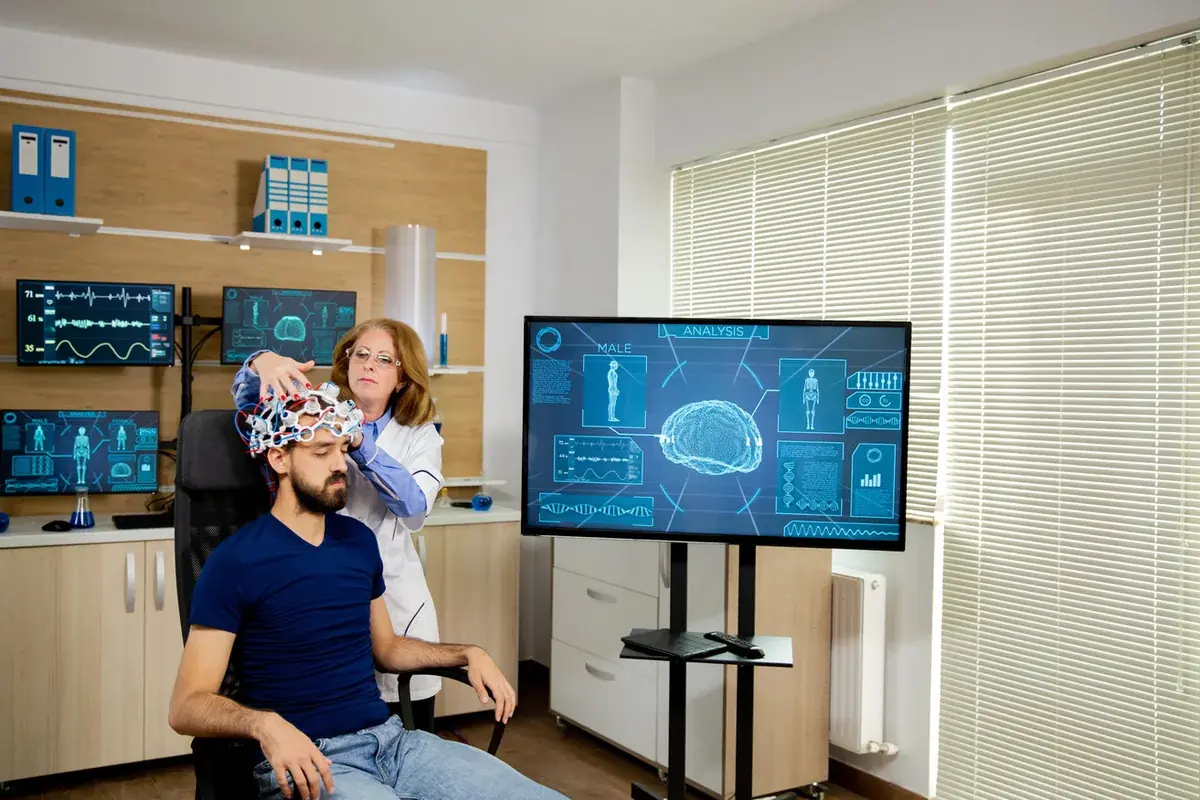
You sit in a comfortable chair while a technician positions the TMS coil against your scalp over the left prefrontal cortex. Each session involves a series of magnetic pulses — you will hear a clicking sound and feel a tapping sensation on your scalp. Most patients describe this as mildly uncomfortable for the first few sessions, with the sensation becoming easier to tolerate over time.
A standard 10 Hz session delivers approximately 3,000 pulses over about 37 minutes. Newer theta burst protocols can deliver the full treatment in as few as three to ten minutes. You remain awake and alert throughout the session, and there is no recovery period afterward.
Treatment Schedule
A typical acute treatment course involves five sessions per week (Monday through Friday) for four to six weeks, totaling 20 to 30 sessions. Some patients begin to notice improvement after two to three weeks, though the full benefit often becomes apparent closer to the end of the treatment course or shortly after.
After Your Treatment Course
Following the acute phase, your psychiatrist will assess your response and discuss next steps. Options may include tapering sessions gradually (such as two sessions per week, then one), transitioning to maintenance TMS sessions as needed, or continuing with medication management and psychotherapy to sustain your improvement.
Types of TMS
Several TMS protocols are currently in clinical use, each with different technical parameters and FDA approval timelines.
Standard Repetitive TMS (10 Hz)
The most extensively studied protocol. It delivers 3,000 pulses per session at 10 Hz to the left DLPFC, with each session lasting approximately 37 minutes. This was the protocol used in the pivotal trials that led to FDA approval in 2008.
Theta Burst Stimulation (TBS)
FDA-approved in 2018, theta burst stimulation delivers pulses in rapid bursts that mimic natural brain rhythms. The key advantage is speed — a full session takes only three to ten minutes compared to 37 minutes with standard TMS. Clinical trials have shown theta burst to be noninferior to standard protocols, meaning it produces comparable results in a fraction of the time.
Deep TMS (H-Coil)
FDA-approved for depression in 2013 and for OCD in 2018, deep TMS uses a specially designed H-coil helmet that stimulates broader and deeper brain regions than standard figure-eight coils. This approach reaches the prefrontal and limbic structures that standard surface TMS cannot directly access.
How Effective Is TMS?
The effectiveness of TMS has been evaluated in multiple randomized controlled trials, meta-analyses, and large real-world datasets.
Response and Remission Rates
TMS outcomes vary by protocol, degree of prior treatment resistance, and how response and remission are defined; many patients with treatment-resistant depression experience meaningful improvement, though results differ between individuals. Response (a clinically meaningful reduction in depression symptoms) and remission (symptoms falling below clinical thresholds) are both realistic goals, but neither is guaranteed, and reported rates differ between controlled trials and real-world practice.
How Long Does Improvement Last?
Many patients who respond to an initial TMS course maintain their improvement with appropriate follow-up care, though durability varies between individuals. Some patients sustain their gains with medication management alone, while others benefit from periodic maintenance TMS sessions. Relapse can occur, particularly in the first several months after treatment, which is why ongoing psychiatric follow-up is an essential part of the plan.
Time to Response
Most patients who respond to TMS begin noticing improvement after two to three weeks of treatment. Some respond earlier, while others require the full four- to six-week course before the benefit becomes clear. It is important not to discontinue treatment prematurely if you have not yet noticed a change — the effect is cumulative.
Side Effects and Safety
TMS has a favorable safety profile compared to both medication and ECT. The most common side effects are localized and tend to diminish over the course of treatment.
Common Side Effects
- Scalp discomfort or pain at the treatment site — Reported by approximately 39 percent of patients, typically mild to moderate, and usually improves after the first several sessions
- Headache — Occurs in about 28 percent of patients; usually responsive to over-the-counter pain relievers
- Neck pain — Occasionally reported, usually related to positioning during the session
Rare Side Effects
- Seizure — The most serious potential risk, occurring in roughly 0.003 to 0.5 percent of patients. Risk factors include a history of seizure disorder, certain medications that lower the seizure threshold, and recent rapid tapering of anticonvulsant or benzodiazepine medications.
- Hypomania or mania — Rare but reported, requiring monitoring especially in patients with a history of bipolar disorder
- Hearing changes — Temporary; ear protection is provided during every session
What TMS Does Not Cause
Unlike many antidepressant medications, TMS does not cause weight gain, sexual dysfunction, gastrointestinal problems, or sedation. Unlike ECT, TMS does not require anesthesia and does not cause cognitive side effects such as memory impairment. This is one of the primary reasons patients choose TMS when medication side effects have been a barrier to treatment.
TMS vs Other Treatments
| Factor | TMS | ECT | Spravato® | Medication |
|---|---|---|---|---|
| Anesthesia required | No | Yes | No (monitoring required) | No |
| Session frequency | 5x/week for 4–6 weeks | 2–3x/week for 3–4 weeks | 2x/week for 4 weeks | Daily (ongoing) |
| Time to response | 2–3 weeks | 1–2 weeks | Hours to days | 4–8 weeks |
| Response rate (TRD) | Varies; not guaranteed | 50–60% | Varies; not guaranteed | Varies widely |
| Cognitive side effects | Minimal | Memory effects possible | Transient dissociation | Varies by drug |
| Can continue working | Yes | Usually not same day | 2-hour monitoring period | Yes |
For a detailed comparison, see TMS vs ECT: Which Treatment Is Right for You?
Insurance and Cost
Many major insurance plans now cover TMS therapy for treatment-resistant depression, though coverage criteria vary by carrier. Most insurers require documentation that the patient has tried and not responded to at least one or two adequate antidepressant trials before they will authorize TMS.
KwikPsych accepts Aetna, Blue Cross Blue Shield, Cigna, UnitedHealthcare, Medicare, and several other plans. Our team handles prior authorization on your behalf and can verify your specific TMS benefits before treatment begins.
For patients without insurance coverage, self-pay options are available. The total cost of a TMS treatment course depends on the number of sessions and the protocol used. We are transparent about pricing and discuss all financial details before the first session.
For more information, see TMS Insurance Coverage: What You Need to Know and How Much Does TMS Therapy Cost?
How It Works at KwikPsych
KwikPsych offers TMS therapy at our Austin clinic under the direct supervision of board-certified MD psychiatrist Dr. Monika Thangada, M.D. Because TMS requires in-person treatment, this service is available at our office at 12335 Hymeadow Dr, Ste 450, Austin, TX 78750.
Step 1: Psychiatric Evaluation
Every TMS treatment plan starts with a thorough psychiatric evaluation (45 to 60 minutes). Your psychiatrist reviews your diagnosis, symptom severity, medication history, previous treatment response, and any contraindications. This is also where we determine whether TMS, Spravato®, or a different approach makes the most sense for your situation.
Step 2: Treatment Planning and Authorization
If TMS is appropriate, we develop your treatment plan, complete insurance prior authorization, and schedule your sessions. Most patients begin treatment within one to two weeks of their evaluation.
Step 3: TMS Treatment Course
You attend five sessions per week for four to six weeks. Each session lasts 20 to 40 minutes depending on the protocol. Your psychiatrist monitors your progress throughout the course, adjusting the treatment plan as needed based on your response.
Step 4: Follow-Up and Maintenance
After your acute course, we schedule follow-up visits to assess sustained benefit, discuss whether maintenance sessions are appropriate, and coordinate any additional treatment — including medication management or therapy referrals.
To find out if TMS is right for you, request an appointment online or call 737-367-1230.
Frequently Asked Questions
What is TMS therapy?
TMS, or transcranial magnetic stimulation, is an FDA-approved treatment that uses targeted magnetic pulses to stimulate nerve cells in areas of the brain involved in mood regulation. It is primarily used for depression that has not responded adequately to medication. The treatment is noninvasive, does not require anesthesia, and has minimal side effects.
How long does a TMS session take?
A standard TMS session takes approximately 37 minutes. Newer theta burst protocols can complete a session in as little as three to ten minutes. Most patients schedule sessions over their lunch break or before work without any disruption to their daily routine.
How long does TMS take to work?
Most patients who respond to TMS begin noticing improvement after two to three weeks of daily treatment. Some patients respond earlier, while others need the full four- to six-week course. The effects are cumulative, so it is important to complete the full treatment course even if improvement is not yet obvious.
Does TMS hurt?
Most patients describe TMS as a tapping or clicking sensation on the scalp. It can be mildly uncomfortable during the first few sessions, but the sensation typically becomes easier to tolerate as treatment progresses. Scalp discomfort and mild headache are the most commonly reported side effects.
Is TMS covered by insurance?
Many major insurance plans cover TMS for treatment-resistant depression. Coverage typically requires documentation that the patient has tried at least one adequate antidepressant trial without sufficient improvement. KwikPsych handles prior authorization and can verify your TMS benefits before treatment begins. See our insurance page for a list of accepted plans.
Can I drive after TMS?
Yes. Because TMS does not involve sedation or anesthesia, you can drive yourself to and from every session. Most patients return to work, school, or other activities immediately after treatment.
What is the difference between TMS and ECT?
Both TMS and ECT are brain stimulation treatments for depression, but they differ significantly. ECT uses electrical currents to induce a brief seizure under general anesthesia and has higher response rates (50 to 60 percent) but carries risk of memory and cognitive side effects. TMS uses magnetic pulses without anesthesia or seizure induction and has a milder side effect profile, with response varying between individuals. Your psychiatrist can help you weigh these options based on your severity, treatment history, and preferences.
Can TMS be combined with antidepressants?
Yes. In fact, most clinical trials of TMS were conducted with patients continuing their antidepressant medication. Combining TMS with pharmacotherapy is common practice and may enhance the overall response. Your psychiatrist will advise whether continuing, adjusting, or changing your medication during TMS is appropriate.
Insurance & Pricing
We accept most major insurance plans, including:
- Aetna
- Blue Cross Blue Shield (BCBS)
- Cigna
- UnitedHealthcare
- Superior HealthPlan / Ambetter
- Baylor Scott & White
- Oscar
- Optum
- Medicare
Plus others. See full list of accepted insurance plans →
Self-pay: Call us at 737-367-1230 to find out latest rates.
Accepted plans and rates are subject to change and are not a quote. Coverage, copays, deductibles, and prior-authorization requirements vary by plan and by your individual benefits — please verify your benefits with us and your insurer before your appointment. If you are uninsured or not using insurance, you may request a Good Faith Estimate of expected charges.